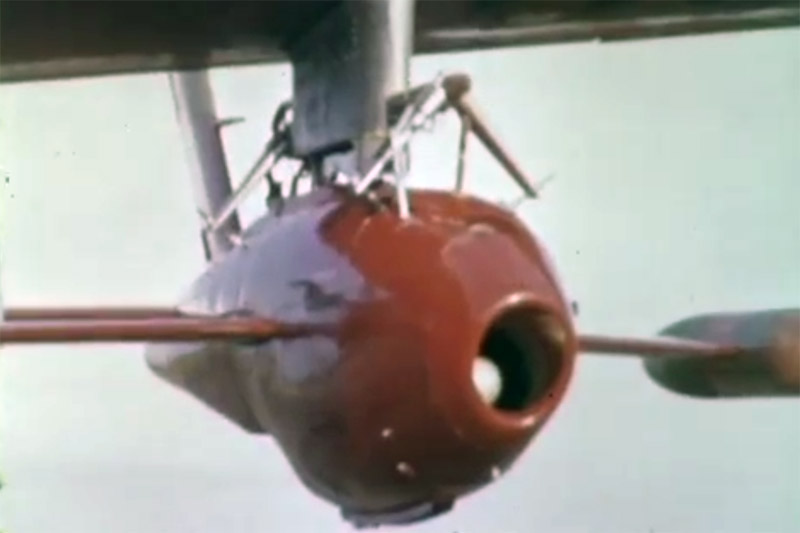
USAF XQ-2 and Q-2A Firebees

The history of the first generation Firebee target drone is very poorly documented. It took a lot of effort and a long time to sort out the USAF side of its development and operational use. However, the end result was reasonably simple. During the R&D phase, most USAF XQ-2s were J44 powered, except a few J69 powered ones at the end of the R&D phase. During the series production phase, only J69 powered Q-2As were built for the Air Force. The J44 XQ-2 and J69 Q-2A had very different inlets, nacelles, exhausts and exhaust areas.
|
USAF versions of the first-generation Firebee
In the pre-1962 USAF type designation system, the first version generally did not get a suffix. The second version got an 'A' suffix, etc. Therefore, theoretically there should be a Q-2 'sans suffix', then the Q-2A, Q-2B, etc. They could be preceeded by the prototype version XQ-2 and pre-production version YQ-2. Which designations were used in the Firebee program? There's no source or document that directly answers this question, but there's enough circumstantial evidence:
the R&D phase involved 32 aircraft paid for by the Air Force (serials most likely GM-901 to 932), and 30 aircraft paid for by the Navy (serials most likely 0001 to 0030). In all photos of Firebees with these serial numbers, these aircraft have 'XQ-2' stenciled above the serial number. This leads to the conclusion that all 62 aircraft were simply designated as 'XQ-2', independent of the procuring service and independent of the engine installed (Flader XJ55, Ranger (later Fairchild) YJ44-R-1 and/or J44-R-20, Continental J69-T-19).
in none of the Ryan production planning charts the YQ-2 occurs.
in none of the Ryan production planning charts the Q-2 'sans suffix' occurs, the type designation 'jumps' from XQ-2 to Q-2A at the switch from R&D phase to series production.
the Q-2B is a bit of a mystery: it does not appear in the Ryan production planning charts - but it could be a later update of the Q-2A, after production. The only reference to was found in Jane's All the World's Aircraft, 1956-57 issue, reporting: "It was also announced that a Q-2B version is being developed with air-to-air radio control, smoke-laying equipment and other changes. It will have greater wing area, improved control system and higher altitude (50,000 ft = 15,240 m) capacity." The larger wing area makes me doubt whether this version ever materialized.
the Q-2C is the largely redesigned version, that is best known as the BQM-34A.
This leaves only the XQ-2 and Q-2A, and possibly Q-2B, as USAF versions of the first-generation Firebee.
USAF serial numbers
I found the serial number blocks for the series-production Firebee in the introduction of T.O. 1Q-2A-2 'Erection and maintenance instructions - USAF model Q-2A aerial target drone missile'. Unfortunately I don't have the real thing, only some random photos from an old Ebay auction.
For each known serial number, the engine type is noted, as seen in photos and films. The pattern for the USAF XQ-2s is clear: most had the J44 engine, and only the last example(s) had the J69 engine. It's also clear that all USAF series production Q-2As were J69 powered.
The 'GM' serial numbers are not listed in Joe Baugher's USASC-USAAS-USAAC-USAAF-USAF Military Aircraft Serial Numbers--1908 to Present, but the 'AF' serials are: 1955 USAF Serial Numbers, 1956 USAF Serial Numbers and 1957 USAF Serial Numbers. The last one reports that 57-2220/2229 were a cancelled contract.
Note that Navy KDA production is not listed here, and neither is M-21 production for the Army.
|
R&D phase
|
| Serial block
| Number
| Examples seen in photos
| Comments
|
GM-901 to 932
(not 100% confirmed)
| 32
| GM-913 (J44) GM-914 GM-918 (J44) GM-924 (J69) GM-930 (J69)
| paid for by USAF
|
0001 to 0030
(not 100% confirmed)
| 30
| 0001 (J55) 0002 (J55) 0010 (J44) 0016? (J44) 0017 (J44) 0021? (J69) 0027 (J44) 0028? (J69)
| pair for by USN
|
Series production
|
| Serial block
| Number
| Examples seen in photos
| Comments
|
| GM54-1512 to 1600
| 89
| 1517 (J69) 1521 (J69) 1524 (J69) 155x
| -
|
| AF55-4760 to 4800
| 41
| 4765? (J69) 4782 (J69) 4784? (J69) 4798 (J69)
| -
|
| AF56-4057 to 4115
| 59
| 4067 (J69) 4087 (J69)
| -
|
| AF57-1515 to 1605
| 91
| 1548 (J69) 1554 (J69) 1579 (J69)
| -
|
| AF57-1930 to 2229
| 300
| 1979? (J69)
| -
|
|
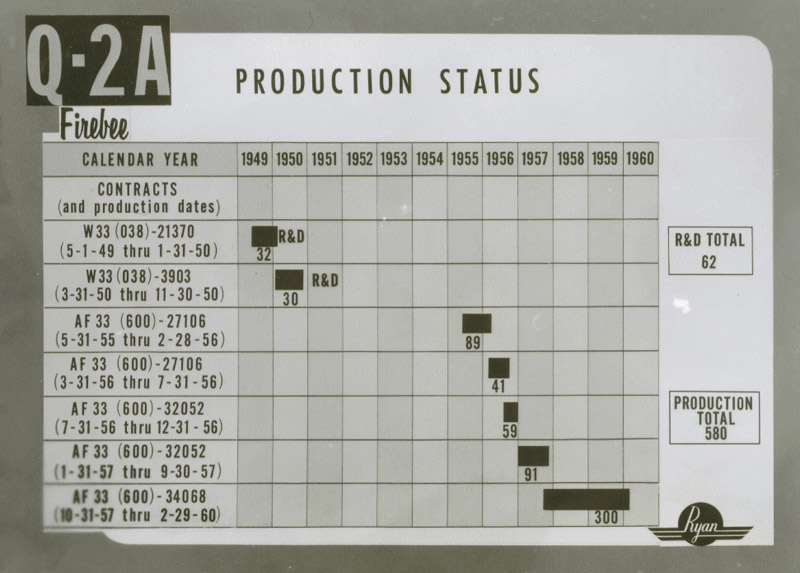
| The series production batches listed above agree perfectly with this Q-2A production overview. It's interesting to see the delay between order (fiscal year) and actual production, that has to be planned and ramped up of course. The production of the last batch of 300 ran to February 1960.
A note for future research: the contract numbers are written in various ways in different publications. This slide shows for example 'W33(038)-21370', that is also written as 'W33-038-AC-21370' or 'W33-038 ac 21370'.
Source: San Diego Air and Space Museum photo archives on Flickr: TRA 2-3357_3
|
Ryan model designations
For the sake of completeness: what Ryan factory model designations applied? Through various searches, including 'Subject Index to Unclassified ASTIA Documents - Volume 8 - 1960' and Title Announcement Bulletin - 1955 - Issues 69-85 - Page 20, the following model numbers emerged:
XQ-2 model 49. Preserved KDA-4 serial number KD-4803 has 'Model 49A' on its data plate, so this model number was retained for the Navy KDA versions, although with an 'A' suffix
XQ-2 model 58. It is not known what it represents
XQ-2 model 61. This is the J69 powered version
Q-2A model 61
These model numbers, except the 'Model 58', are also reported on Secret Projects - Designation Systems - Ryan Aircraft List. A partial quote from American Aviation - Volume 18 - Page 21 also confirms the Models 49 and 61: "Firebee Near Production - Ryan Aeronautical Co. is nearing the mass-production stage on the jetpowered Firebee target drone after lengthy research and development work. Two XQ-2 (Model 49) drones are to be modified into functional Q-2 prototypes (Model 61) by October 1 under an ..."
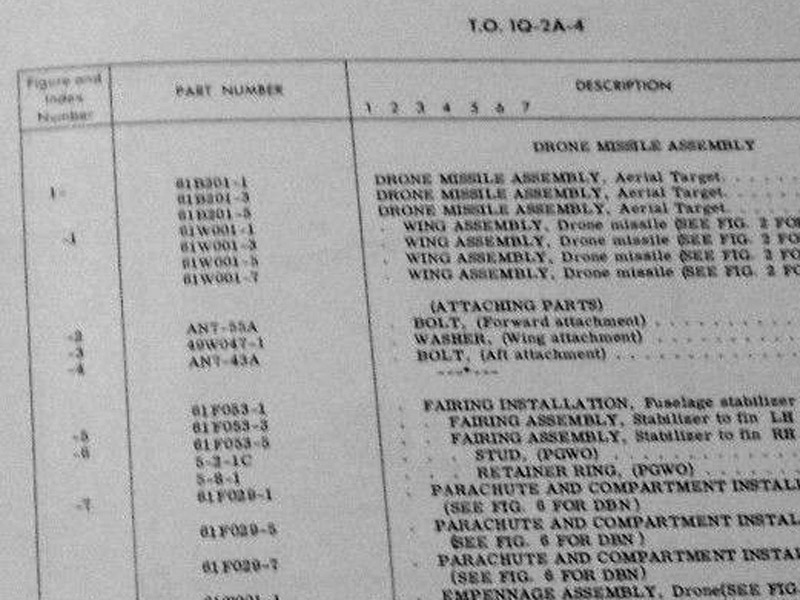
The factory model number '61' is confirmed by this Tech Order 1Q-2A-4 'Illustrated Parts Breakdown - USAF Model Q-2A Aerial Target Drone Missile'. Most part numbers start with 61.
Source: Ebay
| 
|
The first engine: Flader J55
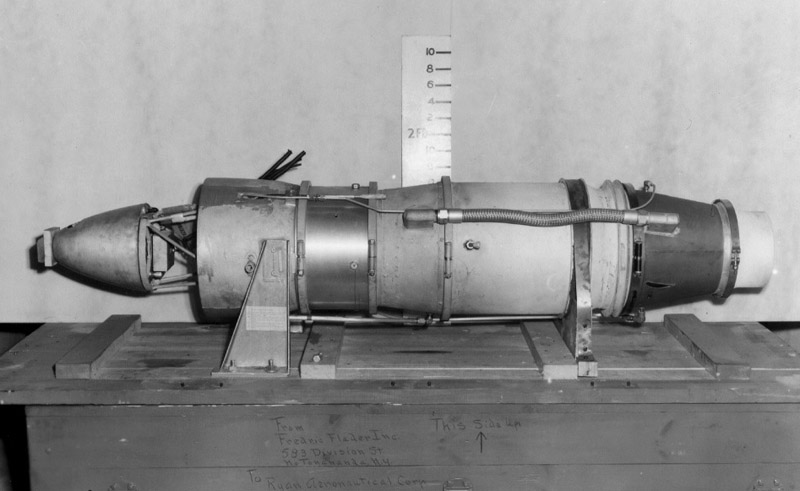
The Flader J55 was selected by the customer, not Ryan, but did not deliver its promises. The Ryan Aeronautical Negative Collection, as posted by the San Diego Air and Space Museum on Flickr, has a set of four photos XJ55. Here's a side view of the engine. It appears to be a shell only, probably for fitting tests.
'Lightning Bugs', page 88, strongly suggests that this engine was never flown in a Firebee: ".. but after numerous tests and ground runs in the XQ-2, the contract was terminated and the Fairchild J44 designated as the replacement engine."
Source: San Diego Air and Space Museum photo archives on Flickr: XJ55
| 
|
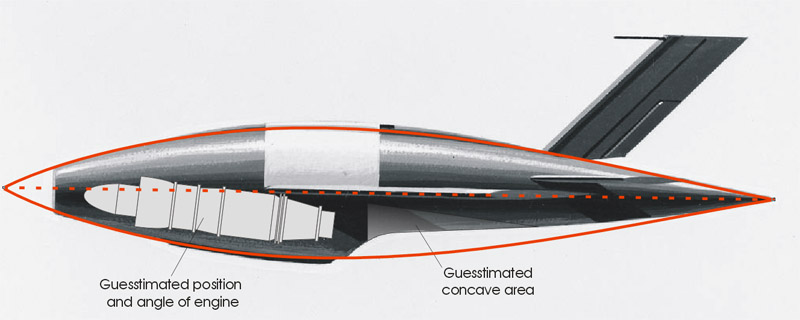
| I used the above photo to make a basic scaled drawing of the engine, and placed it on an approximately scaled XQ-2 sketch. The position and angle of the engine are a guess, but at whatever position and angle, a substantial cut-out in the rear fuselage is required to create a path for the exhaust flow.
I think that the large concave cut-out seen in the photos below are a legacy of the initial J55 engine choice. When the J55 was replaced by the larger Fairchild J44 (again selected by the customer), the engine was installed considerably lower in a larger nacelle. Most of the large cut-out was no longer necessary.
The drawing confirmed another suspicion that I had for a long time: the initial XQ-2 front fuselage design was probably axisymmetric (note I left out the belly skid and the fairing on the spine), but with an oval cross section. What's such a shape called?
Source: San Diego Air and Space Museum photo archives on Flickr: XQ-2 sketch
|
The second engine: Ranger, later Fairchild YJ44-R-1
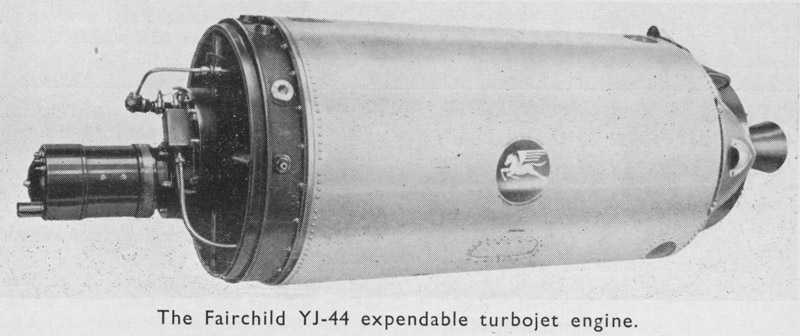
This photo shows the YJ44 (YJ44-R-1) prototype engine. Of note is the simple cilindrical engine casing, stretching for most of the length of the engine. Also note the small cone-shaped oil system exhaust.
More information can be found on this French/English 'Minijets' page: Turboreacteur J-44Q.
Source: Jane's All the World's Aircraft, 1952-53 issue
| 
|
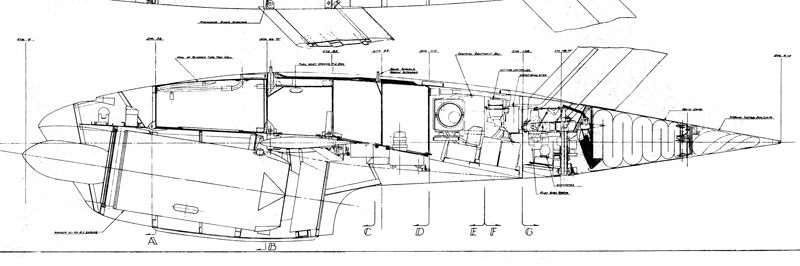
This cross-section drawing shows the XQ-2 (Model 49) with the Ranger YJ44-R-1 prototype engine, according to the annotations. It also shows the large concave area under the rear fuselage nicely.
Source: ?
| 
|

| Note too the '49N***' part number on the nacelle heat isolation padding (?), confirming the Ryan model number.
Source: screenshot from San Diego Air and Space Museum video F-3047 Ryan Firebee Prep
|
This film was shot at the Ryan factory. It suggests that a fair number of YJ44-R-1 engines were used during the XQ-2 R&D phase.
Source: screenshot from San Diego Air and Space Museum video F-3047 Ryan Firebee Prep
| 
|
The third engine: Fairchild J44-R-20
Jane's All the World's Aircraft, 1956-57 issue, has this photo, but does not tell us what version it is. The text only lists the J44-R-3 and J44-R-20 versions, but there were more: R-3 (used for C-82 and C-123), R-12 (dispensable), R-20B (standard engine for Firebee), R-24 (Petrel missile), R-26 (later versions of Firebee), according to this J44 Fairchild, USA Czech webpage. The J44-R-24 can be seen in YouTube videos of jet engine owners running their J44 on their driveways.
Source: Jane's All the World's Aircraft, 1956-57 issue
| 
|
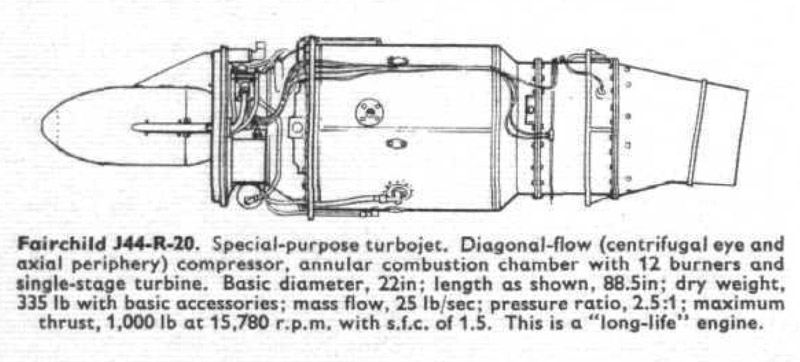
| This drawing from Flight magazine agrees with the photo above, except for the canted exhaust duct.
Source: Flight magazine, 26 July 1957 issue
|
Again from Jane's All the World's Aircraft, a nice cutaway drawing of unknown version. Note that there is no cone-shaped oil exhaust shown in the drawing, instead there's a classic bullet.
Since we only have cross-section drawings that show the YJ44-R-1 and J44-R-20, it's unclear what the J44-R-3 looked like. The R-3 was the initial production version, the R-20 was the developed 'long-life' version, with stainless steel combustion chambers and nozzle guide vanes; reduced weight (according to Jane's 1956-57). The specifications list a length of 95.6" (2428 mm) for the R-3 and 88.42" (2246 mm) for the R-20. R-3 had dual coil and igniters, R-20 single coil and igniter. This suggest that the R-3 and R-20 versions could be visually distinguished.
One possibly distinguishing feature could be the oil system exhaust, that forms an exhaust inside the exhaust. On the USAF XQ-2 and Q-2A Firebee exhaust layout page, it can be seen clearly in the crash photo with the policeman.
Source: Jane's All the World's Aircraft, 1956-57 issue
| 
|

| This drawing represents the Navy's first series production Firebee, KDA-1. In this cross-section, a largely redesigned version of the J44 (J44-R-20) is seen installed. Its exhaust
reaches the end of the nacelle. It appears to have a smaller-diameter exhaust, and this in turn requires a smaller cut-out of the lower rear fuselage. The concave area under the rear fuselage has a kinked edge, as also seen in the following section, about the J69-powered version.
Just maybe, the drawing shows a distinguishing feature that can be seen from the outside: the small air scoop on the side of the nacelle, 2/3s down the engine. Probably this was changed to a sort-of NACA flush inlet later.
Interestingly, a JATO collar attachment bracket on the parachute cone is drawn in.
Source: San Diego Air and Space Museum photo archive on Flickr: Catalog:29-56.tif
|
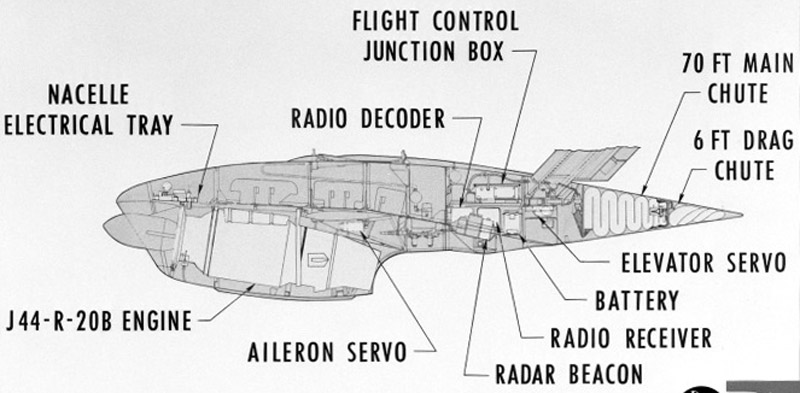
A similar drawing of the KDA-4, the second production version of the Navy's Firebee. The engine is identified as a J44-R-20B.
'Flight' issue 23 December 1960 (page 992) also stated that the KDA-4 had J44-R-20.
Source: San Diego Air and Space Museum photo archive on Flickr: Catalog:C 0352.tif
| 
|

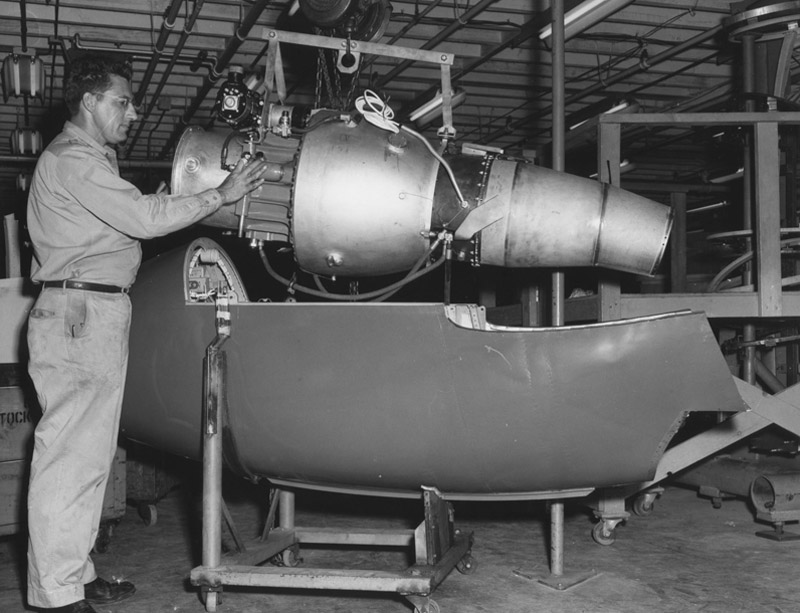
| Shown here is maintenance on Navy Firebee KD-4693 after a salt water landing. The J44 (R-3 or R-20) is removed from the nacelle. The nacelle has the small intake as described four photos earlier, visible as a black spot behind the yellow rear support.
Source: screenshot from San Diego Air and Space Museum video F-2443 Ryan Firebee and Douglas A-26 Invader at Pt Mugu
|
The fourth engine: Continental J69-T-19
The only decent photo of the J69-T-19 that I found so far. However, the nacelle rear side does not show the typical bare metal / silver part seen in all photos above. One explanation is that this is an XQ-2 being fitted with a J69.
Also of note is that the wing cut-out for the straightforward NACA 63A014.63 profile (see BQM-34 wing profile).
Source: San Diego Air and Space Museum photo archive on Flickr: 04-01974 Ryan Firebee Construction c. 1950s
| 
|
USAF XQ-2 in the R&D phase, J55 powered
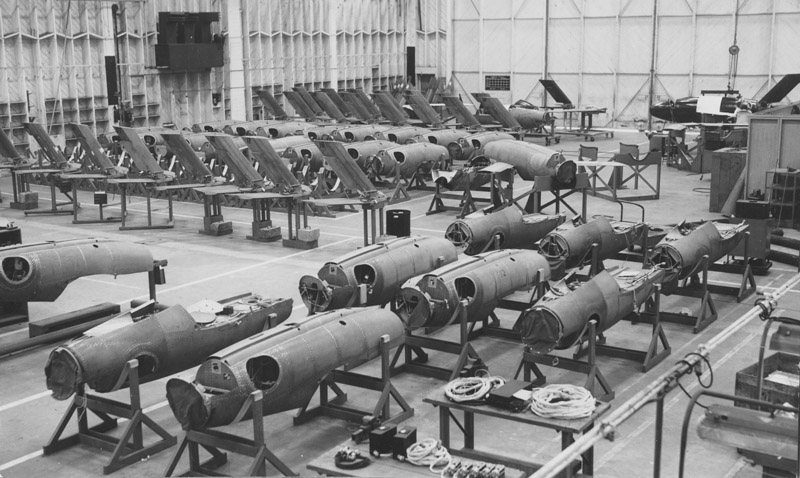
My research on the USAF Q-2 started with this fantastic Ryan production photo that I bought. I'm pretty sure that it shows the first batch being manufactured. I count 28 fuselages and 24 vertical tails. The highest tail number I see is 32. This number agrees with the first R&D production batch shown in the 'Q-2A production status' slide shown above. It would date this photo as late 1949, early 1950. A Flader XJ55 powered XQ-2 prototype is in the back of the hall.
It's interesting that all major airframe components are visible, except the nacelles and the noses (intakes). This suggests that these were still under design / development, which fits the history of the Flader J55 failing, and being replaced by the larger Fairchild J44 during the R&D phase.
The earliest Firebees had circular hatches on either side of the rear fuselage. The hatch on the right side appears to be larger than the hatch on the left side. Later production batches had a rectangular hatch on the left side only, but I do not know when this modification was introduced.
Source: Ryan photo
| 
|
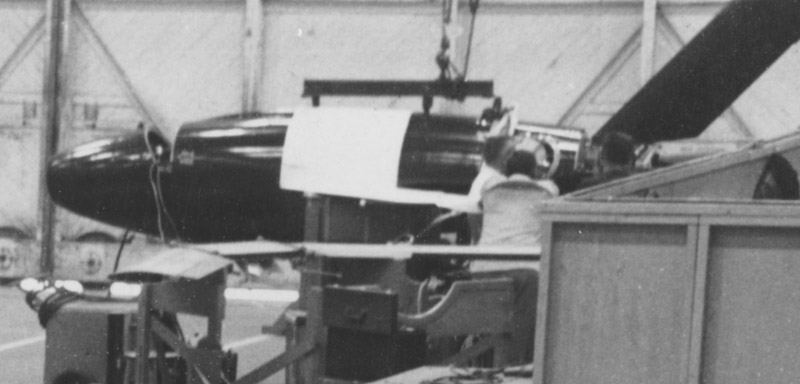
| A close-up of a Flader XJ55 powered prototype, with three people working on it. Clearly visible is the much smaller nacelle height of this version.
Source: Ryan photo
|
USAF XQ-2 in the R&D phase, J44 powered
The stenciled identity 'XQ-2 GM-912' (12 with a big question mark) makes this an Air Force paid XQ-2 with the J44 engine. The use of US Navy style 'TARGET' markings, all over the airframe, instead of Air Force style 'DRONE' is confusing. Maybe Ryan didn't care too much whose painting instructions to follow in the R&D phase, with both Air Force and Navy paid-for examples?
Source: unknown
| 
|
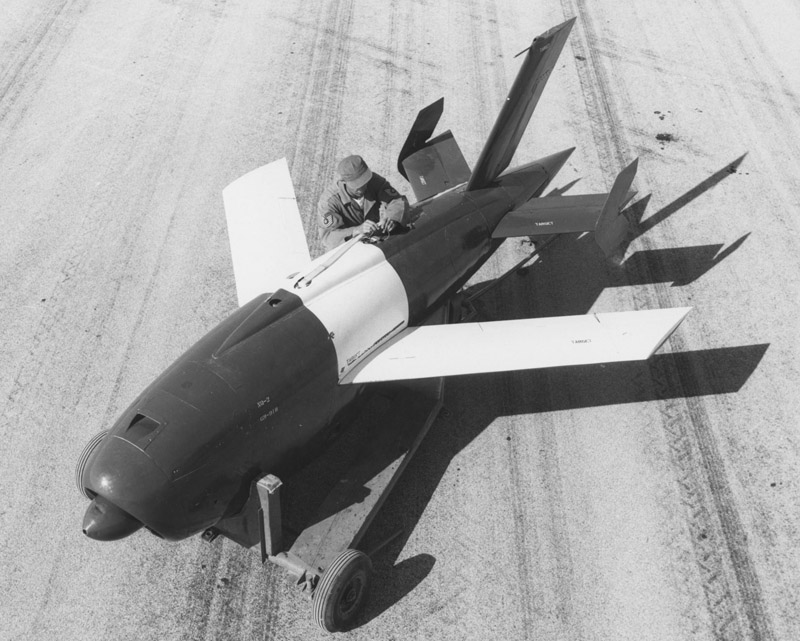
| This Firebee has the stenciled identity 'XQ-2 GM-918', therefore it's an Air Force paid XQ-2 with the J44 engine. It too has US Navy style 'TARGET' stencils on the fuselage, wings and all tail surfaces.
Source: San Diego Air and Space Museum photo archives on Flickr: 04-01945
|
USAF XQ-2 in the R&D phase, J69 powered
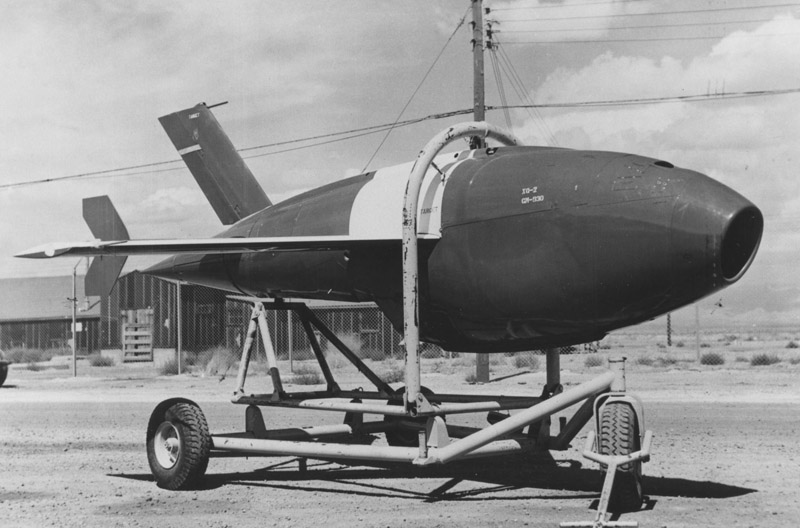
This is the earliest J69-powered XQ-2 that I found so far, GM-930. The nacelle and forward fuselage including engine inlet have been revised completely. The small inlet on the top of the nose appears to one large opening instead of the 'louver' type design on the series production Q-2A.
Source: San Diego Air and Space Museum photo archives on Flickr: 04-01940 Ryan Firebee c. 1950s
| 
|
USAF Q-2A series production, J69 powered
A series production Q-2A, powered by the Continental J69-T-19, with serial AF-55-4798. The use of 'DRONE' stencils on the fuselage instead of 'TARGET' stencils is correct for an Air Force Firebee.
The nacelle has a distinct exhaust area: there's a bare-metal or silver-painted area at the end of the nacelle. Of note is that the the concave cut-out area is shorter: it now stops far ahead of the support bracket to mount it on the cart. Therefore a redesign of the rear fuselage must have taken place.
Note also the 'solid' fin tip. The pitot tube has moved down compared to the XQ-2 with J69 engine.
Source: San Diego Air and Space Museum photo archives on Flickr: Q-2A Firebee AF-55-4798 on ramp, right side_3
| 
|
| I think we see exactly the same configuration here. Photo is dated 22 March 1960 on the back, the DC-130 is probably new. Or maybe called a GC-130A then. This photo shows the shorter concave cut-out area well.
Source: unknown
|
This view clearly shows the downsweep of the rear of the concave area, leaving a bit of circular (oval?) fuselage before arriving at the JATO attachment cut-out.
Source: unknown
| 
|
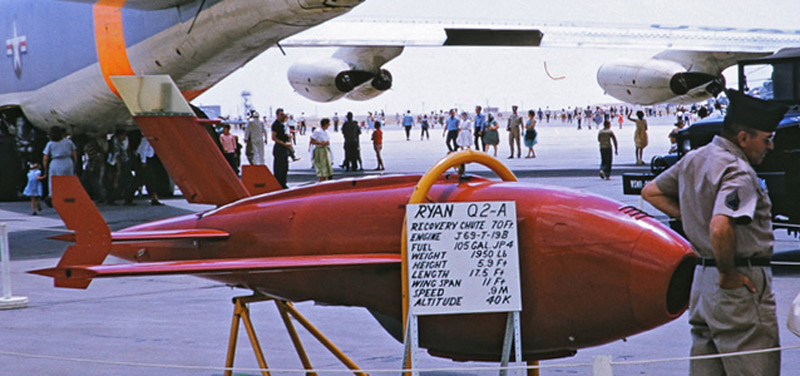
| A photo reportedly taken at a Kirtland air show in the sixties. The paint scheme has been changed to red overall. Note the JATO collar attachment bracket on the parachute cone, visible between the wing and horizontal tail.
The fin tip design has been changed to a glass fiber cover, with one or two antennas underneath.
Source: internet
|
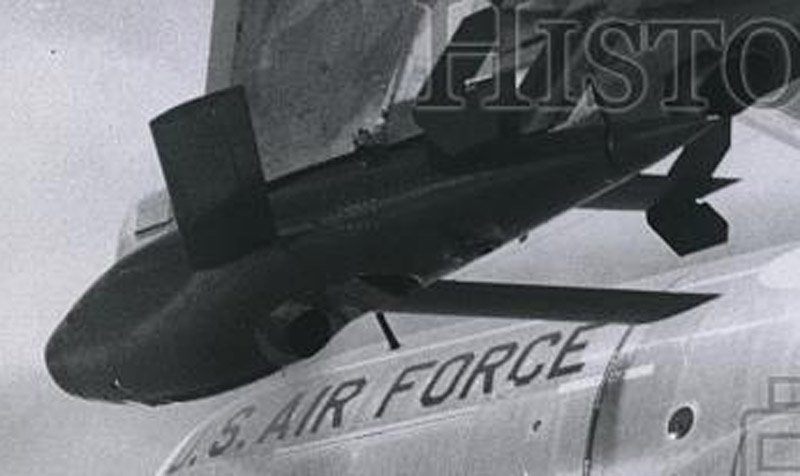
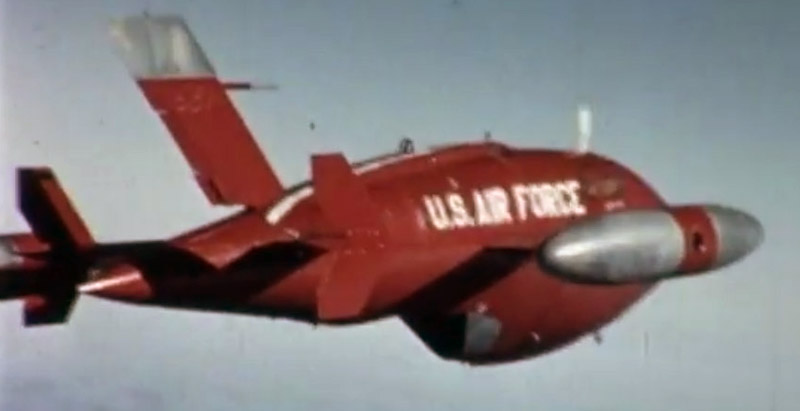
Great in-flight photo, with unusual 'U.S. Air Force' title on the fuselage, and no white band over the fuselage between the wings. Maybe this is the third colors & markings scheme? Again it has the 'silver' area at the end of the nacelle.
Source: screenshot from San Diego Air and Space Museum video F-2619 'Operation William Tell' 1 1959 Ryan Firebee
| 
|
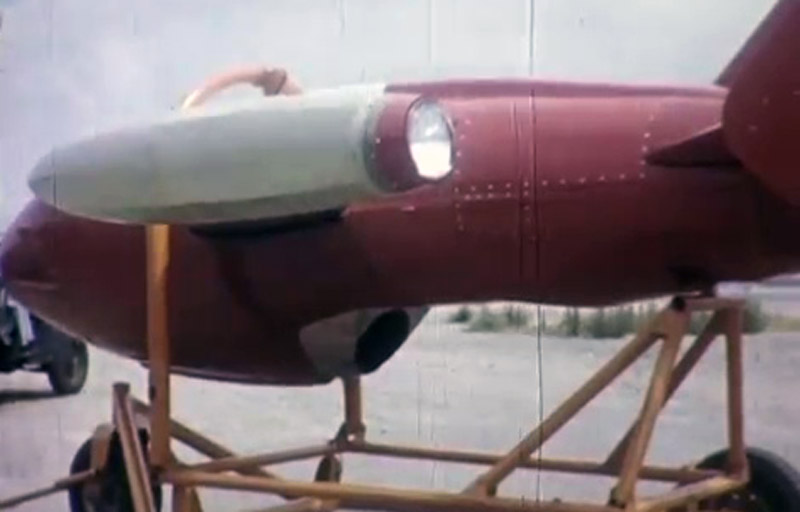
| This Firebee is fitted with a 'rear facing lamp pod' according to the commentary. Note later rectangular rear fuselage hatch, standard on series production Q-2As.
The design of the nacelle around the engine exhaust is well visible. I think we can just see a double belly skid.
Source: screenshot from San Diego Air and Space Museum video F-2656 Ryan "Firebee" Q-2A Drone Douglas A-26, Convair F-102.
|
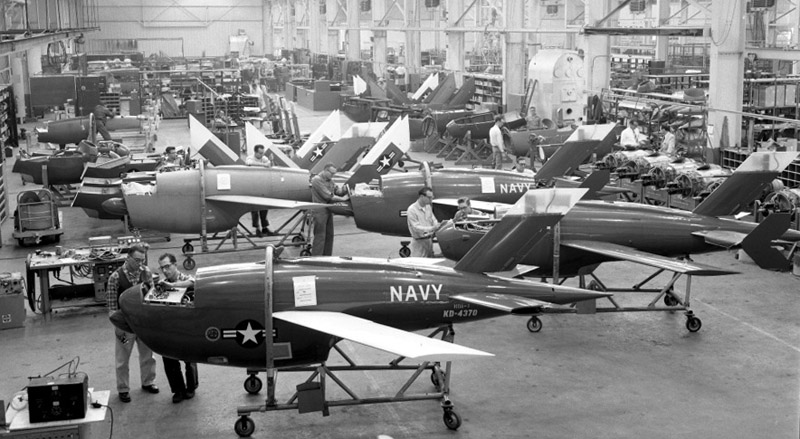
A great photo of the Ryan factory floor. The 'first' Firebee is a Navy KDA-1 (serial KD-4370). The 'second' Firebee is a J69 powered one, presumably for the Air Force. It's already in all-red, and has the transparent fin tip. Note the small cooling air intake on the side of the nose, below the opened electronics hatch.
There are at least six J44 engines on the right, presumably for the Navy Firebees. Also visible are three J69-type nacelles: two left side, mid-height, showing their bare metal ends, and one slightly right and above center, showing its small engine air intake.
Source: San Diego Air and Space Museum photo archives on Flickr: Catalog:A-0076.tif
| 
|
Detail differences in USAF series production Q-2As
To be investigated further:
solid tail fin tip vs transparant one
blade antenna on forward fuselage. Sometimes three?
blade antenna at the rear of the dorsal fairing
small inlet on left side of nose, See factory production line photo, and header photo
JATO collar attachment bracket on the parachute cone, see Kirtland photo
double belly skids?
Appendix: J55, J44 and J69 specifications
| Source
| Manufacturer
| Military
designation
| Factory
designation
| Length
(inch)
| Diameter
(inch)
| Width
(inch)
| Weight
(lbs)
| Takeoff thrust
(lbf)
| SFC
takeoff thrust
(-)
| Normal thrust
(lbf)
| SFC
normal thrust
(-)
| RPM
| Pressure
ratio
(-)
| Mass
flow
(lbs/sec)
| Notes
|
| Jane's All the World's Aircraft, 1951-52
| Flader
| J55
|
| 79
| 15.75
|
| 300
| 770
|
| 700
|
| 28,600
26,800
|
|
| 1
|
| Jane's All the World's Aircraft, 1952-53
| Fairchild
| YJ44
|
| ~72
| 22
|
|
| 1000
|
|
|
|
|
|
| 2
|
| Jane's All the World's Aircraft, 1956-57
| Fairchild
| J44-R-3
J44-R-20
|
| 95.6
88.42
| 22.0
|
| 370 / 416
335 / 391
| 1000
| 1.55
1.5
|
|
| 15,780
|
|
| 3
|
| Flight, 26 July 1957
| Fairchild
| J44-R-20
|
| 88.5
| 22
|
| 335
| 1000
| 1.5
|
|
| 15,780
| 2.5
| 25
|
|
| Jane's All the World's Aircraft, 1956-57
| Continental
| J69-T-19
| 354
|
|
|
| 317
| 1000
| 1.29
| 795
| 1.27
|
|
|
| 4
|
| Aircraft Year Book 1957-1958
| Continental
| J69-T-19B
| 354-10
| 61.53
|
| 22.32
| 317
| 1060
| 1.27
| 860
| 1.25
| 20,500
|
|
| 5
|
| Lightning Bugs
| Continental
| J69-T-19
|
|
|
|
|
|
|
| 880
|
|
|
|
|
|
Notes
1. identical data in 1952-1953 issue. Length with standard tailpipe. Exhaust cone diameter listed as 8.75". Idling thrust 300 lbf.
2. the YJ44's full designation is YJ44-R-1
3. the R-3 is probably a short-life engine, the R-20 is listed as a long-life version, with some different materials. Weights listed as 'dry' and 'complete with accessories'
4. listed as a short-life engine
5. a Continental advertisement also lists a J69-T-19A
6. the J69-T-19 is a licensed copy of the Turbomeca Marbore
|
Navy KDA comments
A BQM-34E/F brochure from ~1970 reports that 200 KDA-1s were built (orders for 40, 80 and 80), followed by 370 KDA-4s from 1958 on. It says the KDA-4 had the Q-2A autopilot, and a drawing suggests a change from a 'solid' vertical tail to one with a glassfiber tip cap. The pitot tube ('Mach meter pick-up') moved down accordingly. But so far the solid tail and pitot tube details don't seem correct.
Unclear: how to distinguish between XQ-2 and KDA-1 & KDA-4 ??
Return to AQM-34 home page