1/72 Pou du Ciel kits: Aeroclub, Aircraft In Miniature and LACI

| For a long time I wanted to build Henri Mignet's Pou du Ciel. Sure, it's ugly, but it's an important part of aviation history. Slowly I collected all Pou du Ciel kits available in 1/72 scale. The oldest was the Aeroclub injected model from 1989, much newer the AIM photo-etch kit from 2012, and in 2021 LACI issued two 3D printed models. A review of the kits revealed numerous problems in all three kits, unfortunately.
|
'The book' and its various editions
Nearly all design information about the Pou du Ciel was described in the book 'Le Sport de l'Air' written by Henri Mignet. The book had multiple editions in French, I hope I found them all:

| 
| 
| 
| 
| 
| 
| 
|
1931
first edition
self-published
? pages
describes HM8
hand-written
| 1932
second edition
editions Fournier
~357 pages
describes HM8
hand-written
| 1934
third edition
'transformée'
impremerie A. Taffin-Lefort
632 pages
describes HM14
| 1937
fourth edition
impremerie A. Taffin-Lefort
506 pages
describes improved HM14
| 1985
reprint
xx edition
impremerie Emile Lormand
632 pages
| 1994
reprint
sixth edition
impremerie Emile Lormand
? pages
online version
contents with links
| 2000
reprint
xx edition
impremerie Gatignol
664 pages
| 2026
reprint
Alain Mignet
720+ pages
|
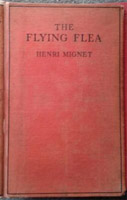
There are only two book editions in English, that are much shorter than the originals:

| 
|
1935
first English edition
Sampson Low, Marston & Co
269 pages
| 1988
reprint of 1935 edition
Greenhill Books
269 pages
|
I found one very puzzling difference in the English book and the Practical Mechanics articles, compared to the 1934 French original: in the rear fuselage, crossbar 85 is placed at 350 mm behind the seatback - but that measurement is 420 mm in the French original! The crossbar's position determines the rear wing's position, and considering that the overlap is critical for the deadly terminal dive characteristics, this is a very significant difference. It *could* result in English Pous being less safe than the French Pous! See Appendix 2 below for more information.
Aeroclub model
| The Aeroclub model comes in a sturdy zip lock bag, with an extra hole punched right through the contents. The kit is from 1989, and it is listed as catalog number K025. I bought mine on Ebay UK in 2018 for 23 pounds (27 euros), shipping to the Netherlands increased that to a whopping 32 pounds (37 euros). The model appears to be based on Shuttleworth Trust example, G-AEBB. Before 1980 it had a Bristol Cherub engine, afterwards a Scott Flying Squirrel Mark A2S.
| 
|

| My kit had two small runners with injected parts, but I've seen photos where the two runners are combined, with the front fuselages connecting to the other runner. Furthermore, it contains centrifugally-cast white metal parts, a vacform part and a decal sheet. The fuselage halves show a lot of shrinkage on the exterior.
The decal set contains two small silverish registrations for the fuselage sides, but the real ones are white. Also supplied are two large registrations in black for the wings, that the real aircraft does not have. Lastly there are four black-only version of a multi-color dragonfly drawing on the rudder.
|
I printed the 1934 fuselage contour on paper in 1/72 scale, cut it out and put it behind the Aeroclub fuselage. It fits reasonably well, except that the rear fuselage is 2 mm too short. On 37 mm that is quite a bit, around 5% of fuselage length, or 1/76 scale. Also, the rear fuselage height tapers a bit too strong, it's missing 0.5 mm at the rear, as can be seen in the photo.
Cockpit wall thickness is 1.3 mm, corresponding to 94 mm in 1 to 1 scale. The real thing is built from 3 mm plywood with a 20x20 mm lath at its edge. This lath is reinforced by another 20x20 mm lath that is thinned towards its ends. In scale this gives us a theoretical 0.04 mm plastic card with an 0.6 x 0.3 mm strip as edge reinforcement.
| 
|

| The model's front wing placed on the book's design drawing shows that it is much too small. The model wing span is 72.8 mm, or 5.24 m whereas 6 meters was standard. The model wing's chord is ~18.7 mm, and it should be 19.4 mm. The ribs are represented by small ridges, the rest of the wing is smooth - it does not show a fabric wing's typical valleys and ridges at all.
|
| The model's rear wing span is 55.3 mm, or 3.98 m, close to the standard 4 meter rear wing span. Chord is similar to the front wing, and thus a bit too small.
| 
|

| The rudder is far too small, when compared to the book's design drawing. The difference borders on ridiculous.
|
The white metal engine is an inverted two-cylinder. It looks a lot like the Scott Flying Squirrel Mark A2S, see Ord-Hume page 48.
Not shown here: the tire diameter is 7.1 mm, or 0.51 m. Recommended real tire size was 450 x 100 mm.
| 
|
Here are the built Aeroclub models (or build reports) that I found:
Aircraft In Miniature (AIM) model
Aircraft In Miniature Limited (AIM) issued a photo-etch model of the Pou du Ciel in 2012. The box reminded me of old East-European quality cardboard - strange for ten year old a model! I bought mine from Hannants in 2018 for 33 pounds (39 euros) plus shipping.
The decals (not shown here) are for Henri Mignet's second aircraft, with separate decals for the fuselage side and rudder, left and right of course. I find the execution far from perfect: the decal artwork for the fuselage is not correct, the alignment of the text on the rudder is not correct, the red areas of the upper and lower sides of the nose are missing, and the red borders of the wings are not included. The instructions show a yellow and red aircraft, but I think it was cream + red, with most likely clear-doped linnen wings.
| 
|

| The kit contains a large fret of photo-etched part (0.4 mm thickness), eight white metal parts, and two vacform parts. The photo etch thickness corresponds to 29 mm in 1 to 1 scale. The real fuselage was built from 3 mm plywood with 20x20 mm reinforcement strips; therefore I don't think that the kit parts are a good representation of the fuselage structure.
|
| I checked the shape of the fuselage with printed 1/72 scale templates. The top (oblique) photo shows that the rear is OK, but the front is off in various ways. The lower photo shows that the rear fuselage length is not correct either.
| 
|

| The kit's front wing has a span of ~85.0 mm (along the curve), or 6.12 m, close to the standard 6 meter wing when curved. Chord is far too small, ~18 mm instead of 19.4 mm.
|
| The kit's rear wing has a span of ~57.8 mm (along the curve), or 4.16 m, probably close to the standard 4 meter when curved. Chord is a bit larger than the front wing, ~18.5 mm.
| 
|

| The rudder looks like an undersized version of the 1934 French rudder design.
|
The kit has two engines. The engine on the left, and inverted two-cylinder, looks a lot like the Aubier & Dunne. It's a pity that part of the cooling fins are not well cast, and that the cylinders are not equal in length. This would be a fantastic opportunity for photo-etched parts: a stack of them would create the best detailed 1/72 air-cooled engine one could imagine.
The engine on the right is a horizontally opposed two-cylinder. It could be the Mengin / Poinsard 25 hp, since Mignet's second Pou briefly had this engine. But I still don't know what is front and back, or up and down.. The instructions contain no information at all.
Not shown here: tire diameter is 7.1 mm, or 0.51 m, like the Aeroclub model.
| 
|
I could not find any built AIM Pou models, or build reports.
LACI model
LACI by Ladislav Hancar in the UK issued two versions of their Pou in 2021: 7201 is a bare-structure version without decals, and 730002, 730005, 730006 and 730007 that are normal 'solid' models, each with decals for a single a British Pou (G-AEEH, G-AEBB, G-AFFI and G-ADXS). 7201 and 730002 are both fitted with a motorcycle AJS V-twin engine, that is not typical for a Pou, unfortunately. The other three kits appear to a Aubier & Dunne two-cilinder engine (not sure though), like designer Mignet's Pou had.
I bought the bare-structure version at Aviation Megastore for 19 euros.
| 
|

| Here's an overview of the 3D printed parts. I hate the supports of 3D printed parts, but admittedly LACI did a pretty good job. The wings are very, very delicate and flexible. They have the 1934 profile with a sharp leading edge. I used a JLC saw to carefully cut away the supports, one by one.
|
| A better look at the fuselage, revealing some printing steps, and a beautiful little engine. But it's not a common engine for Pous.
| 
|

| To check the fuselage, I made a template based on the 1934 (French) / 1935 (English) book's fuselage drawings. Unfortunately, this showed that the fuselage had many problems. The rear fuselage length is ~4 mm too long, the nose around 1.5 mm. The rear fuselage was also 1 mm too high. The rear edge of the fuselage is set at the wrong angle - it should be perpendicular to the top side, but it is perpendicular to the bottom side. All in all, a disappointing result.
In this photo I first noticed the 'strut' behind the engine, inside the truss formed by three much thinner struts. It's not present on the real G-AEEH, therefore it must be a print support. It will be a challenge to remove it without damaging the model, or breaking the thin struts.
|
| The 1936 fuselage template shows that the rear fuselage length is correct for the longer revised Pou du Ciel design, although fuselage height is still ~1 mm too large. Nearly all Pous were of the 1934 design, G-AEEH included, so this fuselage is not correct for 95% of all Pous.
| 
|

| The span and chord of the kit's front wing are correct for the book's 6 meter wing, and rib spacing is correct too. But it looked like the main spar was positioned too far forward. It turned out the drawing was inaccurate (maybe it's more of a sketch?) and the model was correct! However, a photo of Mignet with one of his first wings looks more like the drawing, with the spar further back - puzzling.
The rear fuel tank might be too small - to be checked. The book says the front tank is 12 liters, and may project a bit on the top side (it does in Mignet's planes). The book states the rear tank is optional and 22 liters. The 2 liter oil tank, also behind the spar, is shown in the drawing on the left of the rear tank, on the other side of the rib.
|
| The book's figure 36 shows that the wing tip should be ~360 mm above the wing's bottom, scaling to 5.0 mm in 1/72 scale. On the model I measured approximately 4.2 mm.
| 
|

| The kit's rear wing span and chord are correct again for the book's standard 4 meter wing. But unfortunately the rib spacing is reduced between the root ribs, for reasons I cannot figure out. And where's the rear spar? The overall structure should be identical to the front wing.
|
| The kit's rudder part does not fit well over the drawing from the 1935 English book drawing. It's strange, because the real G-AEEH has the 'book' rudder as far as I can see.
| 
|

| For fun I also put the kit rudder on the drawing from the 1937 French edition. The model's rudder agreed with the top half, but not the bottom half. So I may have found half an explanation, but still it's wrong for G-AEEH.
|
| Here's the model assembled dry. It looks really nice, but you can also see that the rear wing is positioned like the 1936 design, 300 mm (~4 mm) behind the pilot. That layout does not combine with the sharp leading edge wing of the 1934 design.
| 
|

| This view shows a potential problem with the rudder, that touches the ground. Possibly the rudder needs to mounted higher, it's just hanging naturally here. Maybe the rear wheels need a longer strut?
|
Here are some built LACI models or build reports:
Conclusion
For a modeler that wants proper dimensions for a 1934 design Pou du Ciel, the LACI wings are near perfect. But everything else, of all three kits, needs major modifications. I think that scratch building a new fuselage and rudder is easier than modifying any of the kit parts. One of the white metal engines can probably be used. All in all, it's very disappointing!
Links
Appendix 1: The 1934 HM14 versus the 1936 HM14
Most English-speaking readers will only know the 1934 design of the HM14, since the English translation of Mignet's book from 1935 is a translation of his 1934 book. But in 1937 Mignet issued a revised edition of his book, that had quite a few design changes. The book calls it the 'Pou-du-Ciel 1936'. The 1937 version of 'the book' was never translated in English, and is therefore not well-known outside France. Here are the design changes that I found so far:
the front fuselage was made slightly longer (40 mm) to create a larger cockpit
the rear fuselage was made longer (300 mm) to place the rear wing further back
the front wing was moved forward, approximately 100 mm
the rear wing was made movable, to eliminate the fatal dive characteristic of the original Pou
instead of the wings overlapping approximately 200 mm, there is a gap of approximately 180 mm in plan view
the wing profile was changed from the scary sharp-leading edge design to a far more standard round-nose design. As far as I can see, it still has a reflex.
the front spar was made thicker, from 120 to 150 mm
the front spar was moved back 30 mm, the rear spar was moved back 10 mm
the rear spar was made much more substantial, a miniature version of the front spar, instead of two strips glued together
the leading edges of the wings are plywood-covered
the four steel cables to control the front wing ('ab' in the book) were replaced by push/pull rods
the rudder shape was changed, taller and pointier, with a smaller chord. This is probably related to the longer tail arm
the nose was made ~100 mm longer
the rear wheels are replaced by a small skid
The easiest way to spot a 1936 design is the distance between the pilot's back and the rear wing. On the 1934 they almost touch, on the 1936 design there is ~300 mm space between them. The 1936 version is pretty rare, I have seen photos of just a handful.
| To make things a bit more confusing, it seems that there are some differences between the 1934 French book and the 1935 English translation. The English book has a rudder that's 350 mm larger in chord (1120 vs 770 mm). And the '1936' rudder is again different. Shown here from left to right are: 1934 (French) - 1935 (English) - 1936 (French). Note that I had to distort the 1935 and 1936 rudder drawings to achieve the correct height-width ratio. The 1934 rudder sketch was correct.
| 
|
Appendix 2: The French 1934 HM14 versus the British 1934 HM14
I found some strange, unexplained differences between the French and British 1934 HM14. The biggest one is the position of part 90, that in turn connects to crossmember part 88. The main spar of the rear wing connects to 88. Therefore the British rear wing is placed 70 mm more forward.
The dangerous characteristics of the 1934 HM14 were partly caused by the overlap of the wings. The 1937 version has a gap instead of an overlap, in order to solve these problems. I conclude that the British version is very likely more dangerous than the French version, and this might explain the numerous crashes in the UK.
That leaves the question why this crucial dimension was changed in the translation? The value in the French drawing is clearly in another font / handwriting, which makes things even more mysterious.
| 
|

| There are more differences. In the wing drawing, the front spar centerline is at 340 mm from the leading edge in the French version, and 320 mm in the British version. The British value moves the wing 20 mm aft on the rear fuselage, reducing the 70 mm difference from the above drawing to 50 mm. But still.
Another peculiarity is that the sum of the French chord dimensions (330 + 700 + 340) make 1370 mm, whereas the drawing says 1400 mm. Judging from the wing rib drawing and text (not shown here), the 330 and 340 mm values drive the design, and the 700 mm dimension is not shown in the rib drawing.
The circular window is also deleted in the British drawing.
|
Appendix 3: Mignet aircraft after the HM.14
| Year
| Basic type
| Type variant
| Country
| Seats
| Engine
| Weight
| Description
| Pages
|
| 1936?
| HM.15
| HM.15
| F
| 1-2
| 35 hp Poinsard
|
| refined HM.14. Semi-enclosed cockpit. Room for passenger in the back
|
|
| 1936
| HM.16
| HM.16 Pou-Bébé
| F
| 1
| 25 hp Ava
|
| lightweight Pou, tiny, open cockpit
|
|
|
|
| HM.160
| F/CND
| 1
|
|
| translated plans for North America
| 158
|
|
|
| HM.162
| F/CND
| 1
|
|
| tricycle gear
| 158
|
| 1936?
| HM.17
| HM.17
| F
| 1
|
|
| slightly larger HM.16, enclosed
|
|
| 1937
| HM.18
| HM.18
| F
| 1
| 35 hp Mengin
|
| enclosed cockpit
|
|
| 1937
| HM.19
| HM.19
| F
| 2
| 45 hp Salmson
|
| two-seat, enclosed cockpit
|
|
| 1937
| HM.20
| HM.20
| USA
| 1
| 40 hp Cont
|
| steel tube fuselage. Variation of HM.19. Full span flap on rear wing
| 151-154, 163
|
| 1937
| HM.21
| HM.210
| F
| 1
| 70 hp Minie
|
| improved HM.19, enclosed cockpit, airworthiness certificated.
|
|
| 1937
|
| HM.21
| USA
| 1
| 71 hp Rover
|
| steel tube fuselage. Full span flap on rear wing
| 154-155, 163
|
| 1937
| HM.22
| HM.22
| USA
|
|
|
| never built
| 154
|
| 1937
| HM.23
| HM.23
| USA
| ?
| 50 hp Continental
|
| tail wheel moved forward. Full span flap on rear wing
| 154-155, 163
|
|
| HM.24
| HM.24
|
|
|
|
|
| 152, 163
|
| 1944
| HM.28
| HM.280 Pou-Maquis
| F
| 1
|
|
| folding wings, designed as a "command parachute" for a Free French paratrooper commander.
|
|
| 1945
| HM.29
| HM.290 Sport de l'Air
| F
| 1
| various 25 to 70 hp
|
| civilian version of HM.28. Optional enclosed cockpit (usually flown without), folding wings. For amateur construction from plans, available from Falconar Avia.
| 163
|
|
|
| HM.293
| F
| 1
| typ. 50–60 hp Volkswagen
|
| variant for larger pilots. Plans are available from Falconar Avia and also from Rodolphe Grunberg of Rocquefort, France.
| 163
|
|
|
| HM.297
|
| 1
|
|
| ?
| 160, 163
|
| 1952
| HM.31
| HM.310 Estafette
| F
| 2
| 90 hp Continental C90-12F
|
| two-seat, enclosed cockpit
|
|
| 1955
| HM.32
| HM.320
| F
| 1
|
|
| enclosed cockpit
|
|
| 1954
| HM.33
| HM.330 Cerisier en Fleurs
| F
| 2
|
|
| enclosed cockpit
|
|
| 1955/57
| HM.35
| HM.350
| F
| 2
|
|
| enclosed cockpit.
|
|
|
|
| HM.351
| J
| 2
|
|
| enclosed cockpit. Also known as Tachikawa R-HM[4]
|
|
| 1957
| HM.36
| HM.360
| F
| 1
|
|
| enclosed cockpit, improved wing geometry, folding wings. Plans still available from Falconar Avia.
|
|
| 1957
| HM.38
| HM.380
| F
| 2
| 60–100 hp engine
|
| enclosed cockpit, 1100 lb gross weight. Plans still available from Falconar Avia.
|
|
| 1981
| HM.39
| HM.390
| F
| 2?
|
|
| enclosed cockpit.
|
|
Return to models page
