



The chapter about the early TAC Firebees in 'Lightning Bugs' is rather brief. It contains little information on the hardware, and only two vague photos of the 147NA. Paul Dion worked on them from 1970 to 1973 in his last Air Force job, in the 4472nd Support Squadron (SPA) / 4453rd Combat Crew Training Wing, (with SPA short for 'Special Purpose Aircraft'), redesignated to 11th Tactical Drone Squadron / 355th Tactical Fighter Wing on 1 July 1971, the day that 4453CCTW was deactivated. Paul kindly helped to fill in some holes of this largely undocumented history.
First something about the three versions used by TAC in the early years, the 147NA, NC and NC(M-1):
The 147NA (AQM-34G) had the round cross-section nose, like the BQM-34 (target) Firebee. It had a rear fuselage plug like most AQM-34s.
The 147NC (AQM-34H) had a squarish cross-section nose (see the Edwards AQM-34J, which *could* be an AQM-34H), and a rear fuselage plug. The NC was the most frequent flyer. They almost always had ALE-2 chaff pods (or dummies). ECM pods could also be carried, specifically the Hughes ALQ-71 (FM barrage jammer) and the Westinghouse QRC-335 (noise / deception jammer). Jim Rotramel present a history of the use of the ALQ-71 on F-4s and F-105s in Vietnam, that could help understanding the pod configuration.
Both the NA and NC had extended wingtips, probably because of the weight increase caused by the chaff pods.
The 147NC(M-1) (AQM-34J) were just called M-1s in casual flightline conversation, and were identical to the 147NC but with optical glass windows and wings without pylons. This Larry Engesath photo probably shows AQM-34J #24.
None had the ventral fin on the chute housing, these were always removed.
In everyday use they were identified by the Ryan designations and the last two of their serials, like 'NA-6' or 'NC-12'. The official Air Force designations AQM-34H/J/G were not used much. The drones were required to be called 'Spas' in conversation.
The ALE-2 pod is listed as being manufactured by Ryan, Webcor and MB Associates. It was used on the USAF F-4D/E, F-84, F-86, F-100, F-102, B-66, T-33, AQM-34G/H/M/V, US Navy EA-1F and Canadian "EF-101B" and CT-133. At the front of the pod is an air inlet that splits into two tubes. The air travels down the pod and opens up packets of chaff. At the rear the air plus chaff streams combine again and exit the pod through a fairly large notch in the rear cone-shaped part of the pod. Pod length is 13' 10.2" (4221 mm), diameter 19.58" (497 mm), empty weight 217lb (98 kg) and full weight 470lb (213 kg).
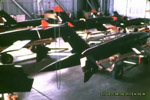
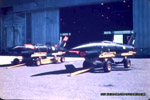
The film F-1533 Ryan Aeronautical Model 147 Combat Angel by the San Diego Air and Space Museum on YouTube starts with an overview of a hangar full of 147NA / AQM-34G and 147NC / AQM-34H, and close-ups of two of them. The second photo shows 147NA / AQM-34G number 7. The fourth photo seems to show number 1, but we cannot see whether it's a 147NA / AQM-34G or a 147NC / AQM-34H (the nose shape is not visible).
|
|
|
|
|
|
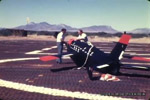
The next section shows a mission with probably one 147NA / AQM-34G and one 147NC / AQM-34H, both without chaff pods. The recovery of the 147NA / AQM-34G number 9 is shown in detail. It has 15 mission markers on the side of the fuselage, seven of which with a parachute, eight without. The meaning of those is not clear.

|

|

|
|

|

|

|
|

|
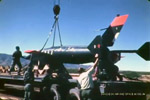
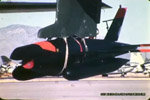
The third section of the film shows a DC-130A with two 147NA / AQM-34G and two 147NC / AQM-34H, each with two ALE-2 chaff pods. The third photo shows 147NC / AQM-34H number 18 on the left outboard pylon. The fifth photo shows 147NC / AQM-34H number 2 on the left inboard pylon.

|

|
|

|

|

|
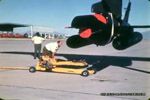
The chaff pods are taken down, starting at the right outboard pylon and working to the left outboard pylon. The first photo shows 147NC / AQM-34H number 1 on the right outboard pylon.
|

|

|
|
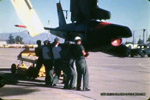
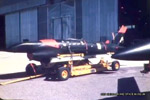
One 147NA / AQM-34G (number 6) and one 147NC / AQM-34H (number 2) are wheeled out of the hangar.

|

|
|

|
|

|
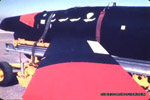
The film ends with some detail views of the 147NC (AQM-34H) with serial number 2.

|
|

|

|

|

|
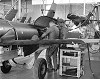
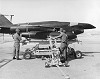
There are not many photos of the TAC 147NA, 147NC and 147NC(M-1). The two photos below (supplied by Craig Kaston) show the NC version. The hangar shot shows from left to right tail codes ? (literally!), 8, 9 possibly, 2, unknown and 5. NC-2 has a mission mark above the wing, and if you look closely you will another on NC-5, partly hidden in the glare.
|
|
Craig Kaston acquired this great Teledyne-Ryan photo (ID number 4-4083C). Craig describes: "We are looking at 147NC-8, photographed on 1 June 1972 on the [then] MASDC ramp (note the C-119, A-3B, HU-16B and Navy B-47 in the background...). NC-8 has one mission marker painted in white, just above the yellow '8', both are behind the red battery compartment cover. The red intake cover is secured by a bungee cord hooked into a hole in the fuselage. The pods are likely ALE-2 dispenser pods. The hole in the nosecone admits the ram air into the pod to dispense the chaff."

|
Craig Kaston found another photo in the former Teledyne-Ryan archive of the San Diego Aerospace Museum. It shows both an NA and an NC under a DC-130A at Point Mugu, possibly for one of the exercises mentioned in Lightning Bugs. The intakes are closed with tape.

|
Former Teledyne-Ryan Aeronautical engineer Ray Vitkus contributed a photo showing two 147NC's at Point Mugu. Quite likely this photo is related to the one above, that shows NA and NC Firebees hung under the Hercules' right wing. They could be NC(M-1)'s, but they were usually not painted black like these two, and camera windows nor protection for them can be seen. The inboard one possibly have the number '6' on the battery cover and clearly shows two mission markings. The outboard one cannot be identified. The vertical tails, and the horizontal tail endplate of the outboard one, look rather lighter than the fuselages, but perhaps that difference is caused by the shadow falling on the fuselages? Just like in the above photo, the intakes are closed with tape.

|
This photo from the Ryan Aeronautical Negative Collection by the San Diego Air and Space Museum on Flickr appears to show AQM-34H #2, along with another AQM-34H, on the pylon of a DC-130. As in the previous two photos, the intakes are taped shut.

|
Another great photo from the Ryan Aeronautical Negative Collection by the San Diego Air and Space Museum on Flickr. It shows AQM-34H #5, with an ALE-2 pod to be loaded.

|
Almost all the TAC NAs and NCs were semi-gloss black overall. Most had International Orange wing tips and stabilizer tips. The battery housing covers were often orange too (see photo of 'NC-5'). A few flew with orange drogue chute cones (BQM-34 Firebee parts), but these were usually sprayed black. The ALE-2 chaff pods were also black to match the drones. All types had dayglow orange index pointers on the endplates to show elevator position to the LCO's sitting in the C-130 doors. A photo of an NC with endplates in orange-black-orange is also known.
The NC(M-1)'s had a two-tone scheme light grey / very light grey (white?) scheme, very Navy looking. At least one (likely an M-1) got a green-green-brown camo scheme a la F-4.
Different markings were carried at various times, reflecting changes in the unit designation:
a small 'DM' tail code in white. A 'DF' code was used for a short period
the drone number was in yellow, or white later, on the tail and at the front of the fuel tank
grey birds carried the same markings in black